Open-plan living is brilliant… until you want to shut the noise out, hide the kitchen, or escape for a bit of peace and quiet.
That’s where sliding room dividers and internal door partitions come in. They let you keep that spacious, airy feel when everything’s open, but quickly create a separate room when you need it – without putting up permanent walls.
In this guide we’ll look at when sliding dividers work best, the difference between internal sliding doors, pocket doors and hinged pairs, plus some real-life style ideas you can use at home.
When do sliding room dividers make sense?
Sliding room dividers are ideal anywhere you want flexible space rather than fixed walls. Common spots we see:
-
Open-plan kitchen / dining rooms – slide the doors across when you’re cooking or hosting, then open them up for day-to-day family life.
-
Lounge and snug / playroom – keep toys and noise tucked away but still easily accessible.
-
Home offices – create a quiet workspace during the day, then slide the doors open in the evening so the room feels part of the house again.
-
Loft conversions – break up long spaces without losing light.
If you regularly catch yourself thinking “I wish I could just close this off sometimes”, a divider will probably make your life easier.
Sliding, pocket or hinged – which type of internal divider?
You’ve got a few options when it comes to internal door partitions. Each has its place.
1. Surface-mounted sliding doors
These are the classic sliding room dividers most people picture.
-
The door or pair of doors slide along a track on the wall or ceiling.
-
Great when you don’t want to lose floor space to a swinging door.
-
Easier to retrofit, because you don’t have to open up the wall.
Sliding doors are ideal along wide openings – think kitchen to dining area, or lounge to snug.
2. Pocket doors (doors that disappear into the wall)
Pocket doors are a step up in neatness:
-
The door slides into a pocket frame inside the wall, so when it’s open you barely see anything.
-
Perfect when you want a really clean look or where wall space is tight.
They do need more planning and a suitable wall build-up, so they’re usually best for renovations and new builds rather than quick weekend projects.
3. Hinged double doors as a room divider
Don’t rule out hinged double doors (like internal French doors) as dividers:
-
They’re brilliant for more traditional homes.
-
You still get that sense of separation when they’re closed, but throw both doors back and the rooms flow together.
This works really well between living and dining rooms, especially with glazed or partially glazed doors.
Style ideas for internal door partitions
Once you know how you’d like the doors to work, you can start thinking about how they’ll look. Below are a few styles we see customers choosing again and again.
White room divider doors – clean and bright
If your home is light and neutral, white room divider doors are a safe and stylish choice. They work brilliantly with Scandi, coastal and modern farmhouse interiors, and they help smaller or darker rooms feel bigger and brighter. White dividers are also easy to pair with almost any flooring and wall colour. You can go for simple white shaker panels for a classic look, or opt for flat white doors if you prefer something very minimal.
Black crittall-style glazed sliders
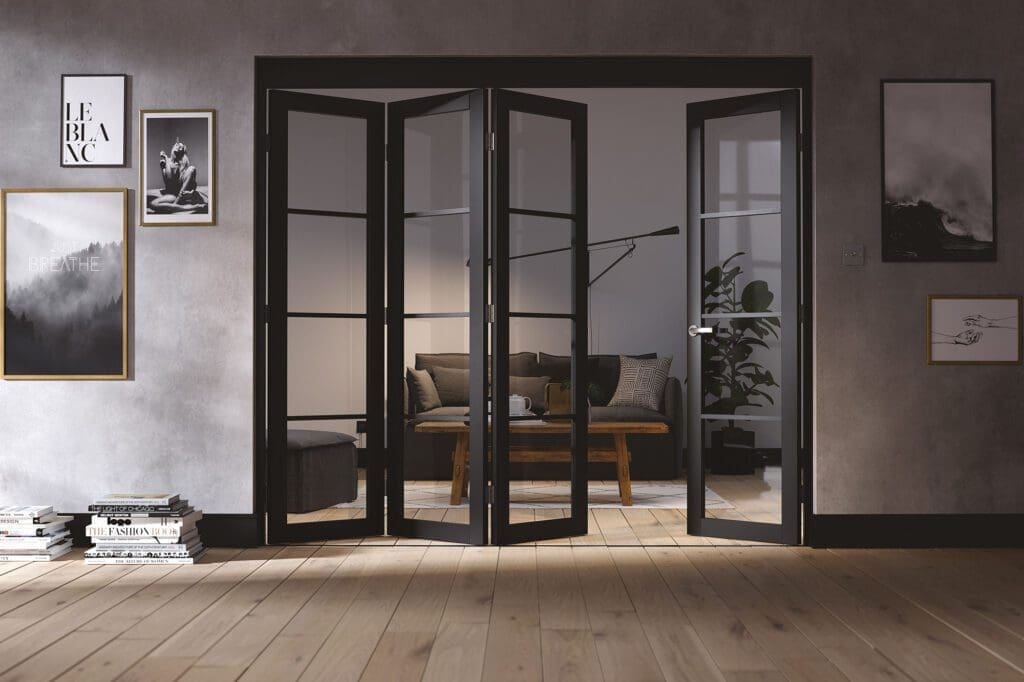
For something more striking, black glazed dividers are a favourite. Slim black frames with multiple panes create that industrial, urban crittall-inspired feel and look fantastic between kitchen and living spaces. You still get light and connection between the rooms, but with better noise control and cooking smells kept closer to the kitchen. Even when the doors are fully open, they make a feature of the opening and add a bit of drama to the room.
Oak and glass for warm, modern rooms
If you prefer a softer, more natural look, oak and glass sliders are a great halfway house. The oak brings warmth and texture, while the glazed panels keep everything open and airy. This combination works nicely in both modern and traditional homes, especially where you already have other oak joinery such as skirting, stairs or furniture.
Double doors as partitions
Don’t forget you can also use pairs of doors as a room divider. Double doors in white, oak or black can sit in a wider frame to create a natural “room break” between spaces. You can mix solid panels for more privacy or glazed panels for extra light, depending on where they’re going. This approach is often more cost-effective than a full glazing system, while still giving a strong visual separation between the two rooms.
Practical things to think about (tracks, soft-close, privacy & light)
Before you choose your divider, it’s worth running through a few practical points.
1. Track systems
Ceiling-fixed tracks give a really clean, minimal look, especially when you’re using pocket doors. Wall-mounted tracks are usually easier to install and maintain, and can be a good option in existing homes where you don’t want to disturb too much plasterwork. Whatever you choose, make sure the track system is rated for the weight and size of your doors. If you’re dividing a large opening with heavy doors, investing in a quality track is worth it – it will feel smoother, last longer and be much nicer to use day to day.
2. Soft-close and ease of use
Soft-close kits are well worth considering if you’ve got children who might slam doors, or if the doors are quite heavy and will be used a lot. They help the doors close gently, make the whole setup feel more premium and protect the track system over time.
3. Privacy vs light
Think about what the divider’s main job is. If you want more privacy or better sound control, go for solid or part-solid doors, or use obscure or frosted glass. If your priority is to keep as much light as possible flowing between rooms, then larger glazed panels or fully glazed doors are the way to go. Many customers end up with part-glazed designs – enough glass at eye level to keep things feeling open, with solid sections lower down for a bit more separation.
4. Floor levels and thresholds
Sliding doors usually work best where floor levels are reasonably even and you’re happy to have a discreet guide or channel at the bottom to keep everything running smoothly. If you’re worried about trip hazards, pushchairs or wheelchair access, it’s worth speaking to your installer so they can recommend the neatest, most practical setup for your home.
How to choose the right sliding room divider for your home
When you’re choosing a sliding room divider, it helps to work through things in a simple order. Start by measuring the opening carefully – note the width and height, and also how much usable wall space you have on each side for the doors to slide across. That will quickly tell you whether a surface-mounted sliding system, a pocket door or a pair of hinged doors is going to be the most practical option.
Next, think about how you actually want the divider to work day to day. Do you want a straightforward sliding track on the wall, a pocket system where the doors disappear into the wall, or a set of hinged double doors that can be thrown open when you want the space to feel completely connected? Once you’ve answered that, you can move on to the fun bit: choosing the style. Decide whether white, oak, or black crittall-style frames will suit your home, and whether you’d prefer fully glazed doors for maximum light or part-glazed designs for a bit more privacy.
It’s also important to be honest about what the divider needs to do. If you mainly want to hide the mess of the kitchen or playroom, or you need better sound control, then solid or part-solid doors are usually best. If your priority is to keep things bright and airy, lean towards larger glass panels. Finally, have a quick chat with your joiner or installer so they can confirm what’s possible with your existing walls, ceilings and floor levels – a few minutes of advice at this stage can save a lot of rethinking later.
Ready to explore sliding room dividers?
If you’re starting to picture how a divider could work in your home, the next step is to look at some real products and layouts. You can browse our internal sliding doors and room divider ideas to get a feel for different styles, and take a look at our pocket door systems if you like the idea of the doors disappearing completely into the wall.
If you’d rather have some guidance, just get in touch with your room measurements and a rough idea of the look you’re going for. We can suggest suitable doors and track systems that will actually work in your space, rather than leaving you to guess. Sliding room dividers are one of those upgrades that can completely change how a home feels day to day; once you’ve got the right setup in place, you’ll wonder how you ever managed without it.


